
WELCOME

Choose a patient
New patient case to come

Not actual patients. Individual results may vary. The responses and adverse events described cannot be guaranteed for all patients
You are leaving the patient record, but you can easily return to it at any time through the menu.
AGE
GENDER
WEIGHT (KG)
HEIGHT (CM)
OCCUPATION
Lifestyle
Athletic
Smoking: 1 pack/day for 20+ years
Lifestyle: High stress
Medical History (Family, Medical, Surgical, Allergies…)
No major conditions reported. No allergy.
Reason for consultation
A 62-year-old male, CEO, consults for nocturia (3-4 nightly voids) upon referral from his general practitioner.
Current treatments
Current medications include a proton pump inhibitor (omeprazole) and acetylsalicylic acid for primary prevention.
Patient interview
Please select the questions from this list that you consider most important to ask your patient:
VERY IMPORTANT
-
Do you have any urinary issues during the day? How is your stream?
-
Have you ever noticed blood in your urine?
-
How much fluid do you drink per day? Do you drink coffee?
-
Do you smoke?
LESS IMPORTANT IN THE CONTEXT
- Hello, Mr Leakman. Your general practitioner referred you due to urinary issues. Could you describe your symptoms?
- Do you experience any pain or burning when urinating?
- Do you experience high levels of stress?
Physical examination
A physical examination was conducted by the physician. The report is as follows:
General examination
- Normal body weight (athletic build, no obesity)
- No sign of edema in the lower limbs
- No sign of dehydration
Digital rectal examination (DRE)
- Prostate is soft, non-enlarged, non-indurated
- No tenderness
GENITAL EXAMINATION
Normal external genitalia, no phimosis or testicular abnormalities
Neurological examination
Perineal sensation and anal tone intact (ruling out obvious neurological dysfunction)
Diagnostic hypotheses
What are your diagnostic hypotheses for this patient’s nocturia? Please rank them in order of likelihood
Prescription of diagnostic tests
Synthesis
Summary of the First Consultation:
The patient presents with nocturia (3-4 voids per night) without daytime urinary symptoms. Given his risk factors (age, smoking history, high stress levels), the differential diagnosis includes:
- Overactive bladder
- Nocturnal polyuria
- Benign prostatic hyperplasia (BPH) with minimal voiding dysfunction
- Bladder cancer (due to smoking history)
- Neurogenic bladder : very unlikely diagnose at this stage
To confirm the underlying cause, a series of diagnostic tests (uroflowmetry,
prostate ultrasound, urine analysis, PSA,
and micturition diary) have been prescribed.
The patient will return for
Consultation
2, where we will review the test
results and adjust management accordingly.
To keep in mind
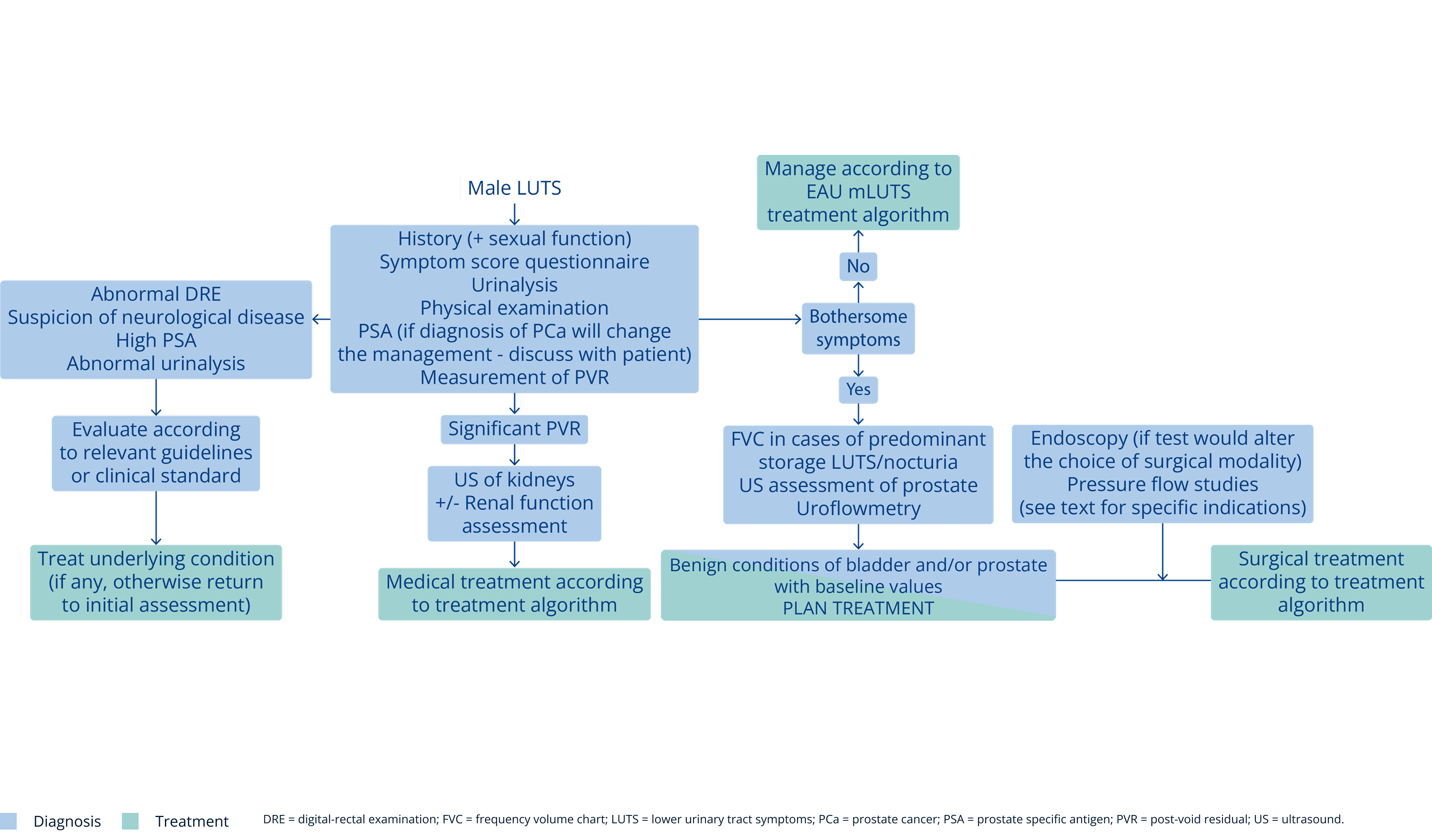
Assessment algorithm of LUTS in men aged 40 years or
older
Readers
are
strongly recommended to read the full text that
highlights the current position of each test in detail.
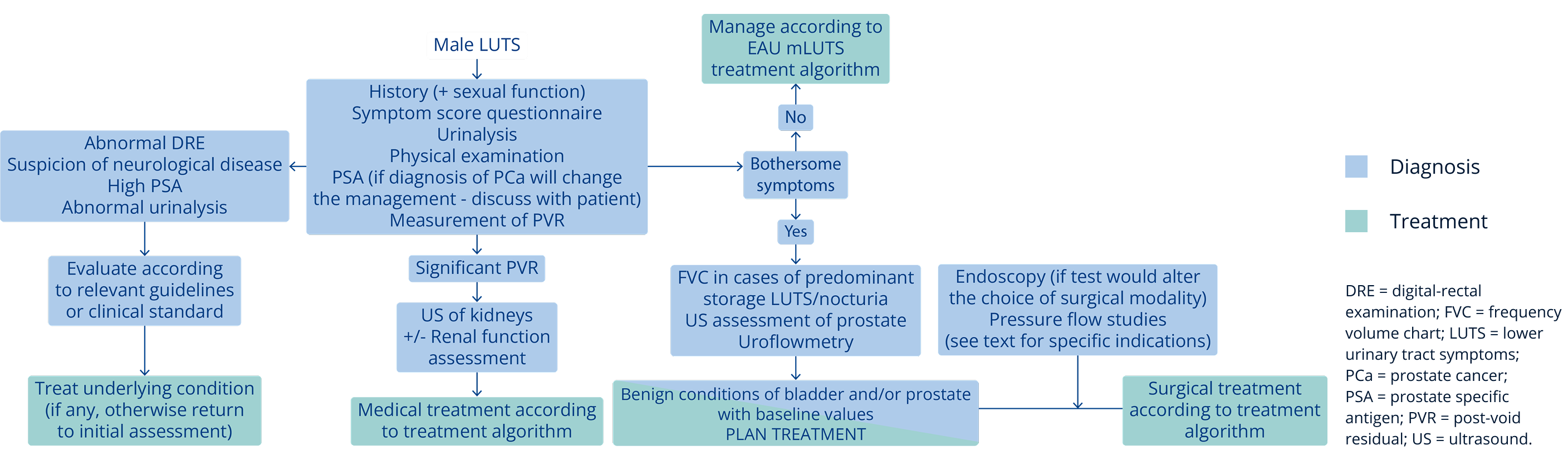
EAU Guidelines on Non-neurogenic male lower urinary tract symptoms 2025 JN Cornu et al.
Diagnostic hypotheses
Are the following diagnoses pertinent, or not, based on the
results?
Select the most relevant diagnosis here.
Patient management
What would be your next step in managing this patient?
Select all that apply.
Additional questions
You are leaving the patient record, but you can easily return to it at any time through the menu.
Congratulations!

You have
successfully completed
the clinical case
It may contain information that is not applicable in your country. Please refer to your local guidelines and prescribing information.
References
- EAU Guidelines 2025 on Non neurogenic Male LUTS. JN Cornu et al.
- McConnell, J.D., et al. The long-term effect of doxazosin, finasteride, and combination therapy on the clinical progression of benign prostatic hyperplasia. N Engl J Med, 2003. 349: 2387. https://pubmed.ncbi.nlm.nih.gov/14681504/
- Sakakibara R et al. (2010), Bladder function in multiple system atrophy: When does it start and how does it progress?, Neurourology and Urodynamics, 29(4): 580–585, DOI: 10.1002/nau.20812
- Campbell NL et al. (2016), Use of the Anticholinergic Cognitive Burden Scale in Research and Practice—A Review. Archives of Gerontology and Geriatrics, 62: 149–158. DOI: 10.1016/j.archger.2015.11.007
- J. L. H. R. Bosch and J. P. Weiss, “The Prevalence and Causes of Nocturia,” JURO, vol. 189, pp. S86–S92, 2013, doi: 10.1016/j.juro.2012.11.033
- Kheir GB, Verbakel I, Wyndaele M, Monaghan TF, Sinha S, Larsen TH, Van Laecke E, Birder L, Hervé F, Everaert K. Lifelong LUTS: Understanding the bladder's role and implications across transition phases, a comprehensive review. Neurourol Urodyn. 2024 Jun;43(5):1066-1074. doi: 10.1002/nau.25304. Epub 2024 Jan 30. PMID: 38289317.
- Chapple CR et al. (2013), Long-term safety and efficacy of mirabegron in overactive bladder: a multicenter, open-label, phase III study. European Urology, 65(1): 109–120. DOI: 10.1016/j.eururo.2013.07.034
- Wagg A et al. (2017), Persistence and adherence with mirabegron versus antimuscarinic treatments for overactive bladder: A real-world, retrospective, comparative study in the UK. BMJ Open, 7(10): e017980. DOI: 10.1136/bmjopen-2017-017980
- Wagg A et al. (2020), Efficacy, safety, and tolerability of mirabegron and solifenacin, alone and in combination: a systematic review and meta-analysis of phase II–III studies. European Urology Focus, 6(4): 729–743. DOI: 10.1016/j.euf.2019.05.006

You are about to exit the video.
Do you want to continue?